



AI SPOTLIGHT

We put the most innovative startups in the construction, AI, and robotics industries in the spotlight.

Start-ups in focus

  • We present start-ups' ideas, technologies, and visions in short portraits, presentations, and interviews – from smart construction management and digital planning to robotics on the construction site.
To the start-ups
Conbotics

Start-ups in focus

We introduce three start-ups.


syte, real estate & land analysis powered by AI

Syte is a German tech startup based in Münster that fundamentally simplifies real estate and land development decisions with an AI-powered data platform. The company digitizes zoning laws, existing property data, and development potential, making this information accessible in real time for professionals in the real estate sector.


What does Syte do?


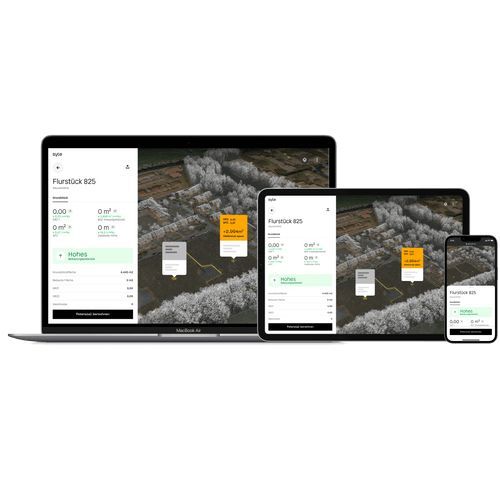
Syte offers an AI platform that consolidates all relevant property and building data and derives real-time insights into opportunities and risks. At the push of a button, the software reveals infill potential, zoning possibilities, energy retrofit opportunities, and economic scenarios for a given property. Users receive a kind of “X-ray view” of the asset: from cadastral and LiDAR data to building regulations and development scenarios.


Products & Features


Asset Analysis: Automated real-time evaluation of land and building stock based on cadastral, LiDAR, and other specialist data.


Zoning & Infill Potential: Identification of how a plot can be better utilized within existing zoning regulations.


Renovation Plans: AI-supported, standardized renovation scenarios including energy efficiency impacts and investment estimates—also used for bank consulting.


The platform is offered as a web app and B2B SaaS, and can be integrated into existing systems via API. Syte emphasizes data reliability: All AI-generated results are currently verified by expert teams to ensure accuracy and build trust.


Innovation & Benefits


Syte combines comprehensive geospatial data, zoning law, building stock, and AI into a single platform—replacing fragmented and manual analyses. Compared to traditional appraisals and one-off evaluations, the software offers significant time savings, improved comparability, and rapid identification of hidden value potential. For banks, municipalities, and developers, this enables more transparent, scalable, and well-documented investment, financing, and planning decisions.

CONSTRUCTION AI- Planning Agents

BAU AI is developing an innovative, AI-powered "all-in-one" platform specifically for the construction industry. The goal is to digitally support and optimize all phases of construction projects – from planning and task management, scheduling and procurement to document management and project monitoring. It offers an intelligent AI agent that automates task management, optimally plans resources (personnel, equipment, materials), simplifies procurement and scheduling, analyzes and organizes documents, creates intelligent reports, detects delays and bottlenecks early on, and enables real-time communication with partners and suppliers. The solution is particularly aimed at small and medium-sized construction or trades companies and is designed as a cloud-based platform. Its innovation and advantage: Automation of entire workflows: AI agents replace many manual, error-prone routines in the daily business of construction management, scheduling, and administration. Real-time early problem detection: The AI agent detects bottlenecks, delays, and cost risks, and immediately proposes countermeasures or alternative solutions. Centralized platform instead of isolated solutions: All project participants work in a single environment, eliminating data silos and increasing collaboration efficiency. Time and cost savings: The high degree of automation enables projects to be completed faster, more cost-effectively, and with less stress. Low barrier to entry: The application is ready to use immediately, affordable—and even free to use during the beta test. Market position: Young startup, big ambitions: BAU AI was founded in 2025 with a small, specialized team and relies on rapid, practical product development. Focus on SMEs: Unlike many other construction software systems, BAU AI explicitly focuses on SMEs with the lowest possible costs and implementation effort. Beta and pilot phases: BAU AI specifically seeks pilot customers to test the system and contribute feedback to its further development. Market differentiation: While many AI startups in the construction industry focus on planning automation, BIM, or sensor technology, BAU AI focuses on digital construction site management for daily operations. We believe that BAU AI is one of the most promising construction tech startups of 2025. Its comprehensive platform and AI agent approach stands out because it specifically digitizes small and medium-sized construction companies – in all project phases, not just planning. BAU AI's innovation lies particularly in its combination of automation, rapid process optimization, and simple, cost-effective implementation. The key advantage: Not an isolated solution, but a complete workflow system that thinks ahead, proactively identifies risks, and thus saves time, stress, and money. Especially for companies with little digitalization to date, BAU AI is an entry-level option with real efficiency gains and a competitive advantage.

Conbotics

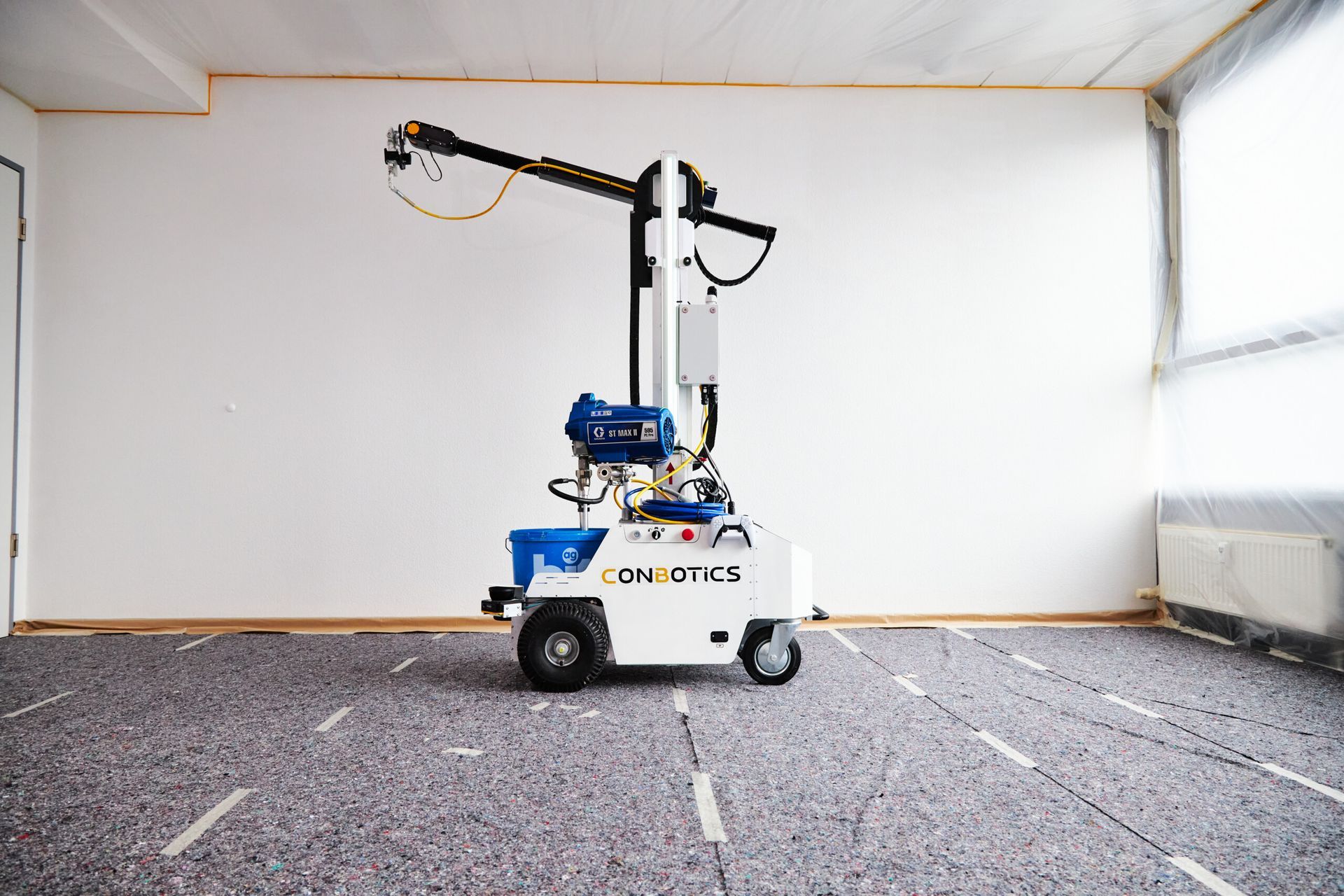
ConBotics is a Berlin-based robotics startup that automates standard painting tasks on construction sites using a painting robot, helping to relieve skilled labor shortages. The founding team—Philipp Heyne, David Franke, and Cristian Amaya Gómez—brings experience from TU Berlin and the Fraunhofer IPK, and is developing lightweight, modular construction robots optimized specifically for interior finishing work.


What does ConBotics do?


ConBotics offers an indoor painting robot that automatically sprays walls and ceilings, mimicking the typical movements of a professional painter. Using sensors and AI, the robot detects walls, windows, and doors and coats large surfaces evenly and reproducibly in professional quality. The solution targets painting companies and construction firms seeking to work faster on job sites with fewer personnel.


How it Works & Applications


The painting robot is composed of multiple lightweight modules and is considered one of the lightest painting robots worldwide. The heaviest component weighs only a few dozen kilograms, making it highly portable. It is intentionally designed to be simple to operate so that painters don't need robotics expertise: the system is brought into the room, set up, and then takes over large-scale spraying largely autonomously. In practice, the robot can complete tasks about twice as fast as manual labor—with significantly less staffing and consistent quality over long shifts.


Innovation & Benefits


Productivity: Painting tasks can be completed much faster, reducing the need for manual surface labor—addressing the skilled labor shortage in the trades.


Quality & Health: The machine delivers highly consistent layer thicknesses, saves materials (up to 20% in paint), and reduces physical strain and inhalation of spray mist for the team.


Modularity & Scalability: The system is modular and can potentially be adapted for other interior trades like floor coating, sanding, or plastering.


Business Model & Market Position


ConBotics was founded in Berlin in 2021 and positions itself as a specialist in robotic solutions for the construction industry. The initial market entry took place via a rental model in Germany; since 2024/2025, the robot is being gradually rolled out for sale, with initial pilot and sales projects especially in Asia (including Singapore and potentially Japan). Supported by industrial and chemical partners (e.g., Uzin Utz, Triflex, Follmann), ConBotics aims to build a modular platform for construction robotics and establish itself as a technological pioneer in automated surface finishing for interior construction.

Interview with syte

Interview by the AI Architecture Group  with the start-up syte


The PropTech start-up syte specializes in the early phase of project development. The platform consolidates site analysis, potential assessment, and visualization into a digital workflow. At Expo Real 2025, we spoke with Anika Meisters about data-driven decision-making, AI in the research process, and the growing pressure for efficiency across the industry.


What exactly does syte do – and where in the project lifecycle does your work begin?


syte: Our focus is on the first mile of a project – meaning the question of whether a site or idea is viable at all. Many developers need to use various tools and data sources to assess this. We combine those steps within a single platform.


With syte, users can conduct a location and potential analysis in a matter of minutes: from zoning and land-use plans to market data and urban-planning parameters. The goal is to digitize the initial feasibility check to enable reliable decisions early on – before costly resources are committed.


You talk about AI-supported research. How does that work in practice?


syte: Today, part of the contextual research – meaning the collection of background information such as press coverage, political decisions, or urban development plans – still takes place outside of syte, using tools like ChatGPT. Currently, several systems are needed for that workflow.


In the future, we aim to integrate this classical location research into syte: Which projects are planned in the district? How is the public perception? What risks are emerging?


In the long term, this AI-assisted research process will run directly inside syte so that data collection, analysis, and decision support are combined in one system.


What happens next – from analysis to presentation?


syte: syte already includes an initial integrated visualization tool. It allows analysis results to be processed and displayed directly, and we will expand this functionality further.


Afterwards, our customers use additional AI tools such as Gamma to automatically generate presentations based on the data produced within syte. This step comes downstream: syte provides the data and visualizations, Gamma turns them into polished presentation materials.


This turns a workflow that used to take days into something that can often be completed within a morning.


You combine software with architectural expertise – how does that work?


syte: Our founder Matthias Zühlke is an architect and a partner at Maas und Partner. The idea emerged directly from his daily practice: “I want everything in one platform.”


That is why, in addition to software, we offer an optional expert analysis. When a customer identifies a promising opportunity, they can commission an architectural feasibility study – prepared by our architects within one business day. This validates the data-driven assessment before further investment steps are taken.


This model is attractive both for major developers with limited in-house resources and for smaller firms without internal architectural departments. They save time, avoid tying up personnel, and can decide within days whether a project is worth pursuing.


What is currently driving demand for such solutions the most?


syte: The market is under pressure: fewer transactions, fewer staff, higher expectations. The key question is: where is effort truly justified?


In the early phase, the risk-reward profile becomes clear. This is where AI and machine learning create the greatest efficiency gains. We help developers identify the right projects faster – and rule out the wrong ones at an early stage.


What is next for syte?


syte: We are currently preparing our Series A financing round, which includes expanding internationally. Our goal is to establish syte as the central platform for early-stage project development – combining AI-driven analysis with architectural expertise.


In other words: developers should deploy their resources where they create real impact – not in research, but in realization.